China Top 10 Threaded Linear Shaft Suppliers?
China’s precision-component market has become an important source for threaded shafts used in linear motion systems. However, “Top 10” should not mean the largest factory names alone. It should reflect measurable performance, application experience, and dependable communication.
A Threaded Linear Shaft must match the actual motion requirement. Buyers should examine steel grade, thread profile, straightness, surface hardness, corrosion protection, and dimensional tolerance. A shaft may look polished under warehouse lighting, yet fail after repeated cycling. The critical details often appear in inspection records, not product photographs. Manufacturing quality expert W. Edwards Deming offered a useful principle: “Quality comes not from inspection, but from the improvement of the production process.” This idea fits threaded-shaft sourcing closely. Stable production matters more than repairing inconsistent batches later.
This guide reviews ten Chinese suppliers through practical purchasing criteria. These include CNC capability, grinding accuracy, custom thread support, sample testing, traceability, packaging, and export experience. It also considers whether suppliers explain technical limitations clearly. That matters. A responsible manufacturer should discuss load direction, lubrication, installation alignment, and expected service life. Some suppliers may offer attractive prices but limited evidence. Others may quote longer lead times while providing stronger inspection control. No ranking is perfect. Supplier data changes, and buyer requirements differ. Still, careful comparison can reduce costly mistakes. A shaft with a clean thread, consistent pitch, and protected surface can keep a compact automation assembly moving smoothly, quietly, and predictably.
What Are Threaded Linear Shafts and How Are They Used?
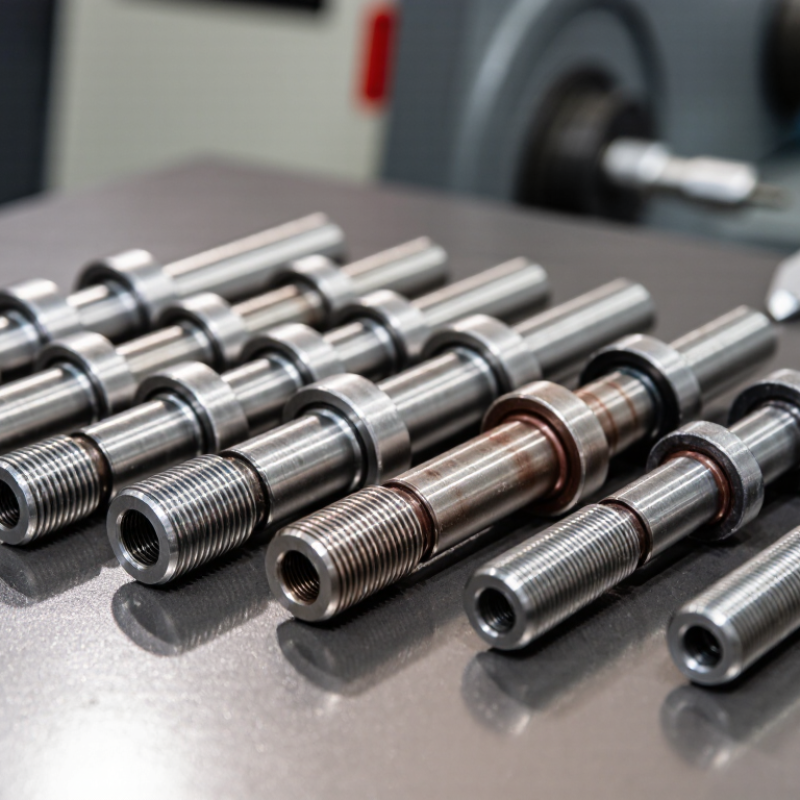
Threaded linear shafts are rotating shafts with helical threads that convert motor torque into controlled linear movement. Unlike smooth shafts, they can push, pull, lift, or position a component along a fixed path. Common designs include lead screws, ball screws, and threaded rods. Selection depends on load, travel length, speed, accuracy, and duty cycle.
A 2024 Grand View Research report estimated the global linear motion products market at about USD 10.7 billion in 2023, with continued growth expected through 2030. This demand reflects automation in packaging, machine tools, medical equipment, and semiconductor production. In practical use, a lead screw suits moderate speed and high holding force. A ball screw usually offers higher efficiency and repeatability, but it needs cleaner installation and better alignment. Small errors matter.
Engineers should check thread pitch, shaft diameter, permissible buckling load, backlash, and lubrication intervals. ISO 3408-1 provides terminology and performance guidance for ball screws, while ISO 286-1 supports dimensional tolerance selection. A shaft that looks strong may still bend under compression. That mistake is common. Temperature, dust, and uneven mounting can also shorten service life. Load calculations should use real acceleration data, not catalog assumptions. I would also leave a safety margin, because laboratory conditions rarely match a factory floor.
China Top 10 Threaded Linear Shaft Suppliers? - What Are Threaded Linear Shafts and How Are They Used?
Comparative overview of typical China-based supplier capabilities for threaded linear shafts and related precision motion components
| Rank | Supplier Profile | Common Product Focus | Typical Materials | Thread Standards | Typical Diameter Range | Typical Length Capability | Surface Treatments | Typical Applications | Customization Capability |
|---|---|---|---|---|---|---|---|---|---|
| 1 | Supplier Profile A | Precision threaded shafts and lead-screw assemblies | Carbon steel, alloy steel, stainless steel | Metric, Unified, trapezoidal, ACME-type profiles | Approximately 6–50 mm | Typically up to 3,000 mm; longer lengths may require support | Black oxide, zinc plating, hard chrome, nitriding | Automation equipment, positioning stages, inspection machines | Custom diameter, pitch, end machining, nut matching, and packaging |
| 2 | Supplier Profile B | Ground and rolled threaded motion shafts | Bearing steel, stainless steel, medium-carbon steel | Metric fine and coarse threads; trapezoidal threads | Approximately 8–80 mm | Commonly 500–4,000 mm | Induction hardening, chrome plating, phosphate coating | Linear actuators, packaging systems, material-handling equipment | Thread class, straightness, runout, keyways, and custom end features |
| 3 | Supplier Profile C | Stainless threaded shafts for corrosion-sensitive equipment | Austenitic and martensitic stainless steel | Metric, Unified, left-hand and right-hand threads | Approximately 5–40 mm | Typically up to 2,500 mm | Passivation, electropolishing, fine polishing | Food-processing equipment, laboratory devices, medical machinery | Material certificates, clean-surface finishing, special thread orientation |
| 4 | Supplier Profile D | Cold-rolled threaded shafts for general motion control | Medium-carbon steel, alloy steel, stainless steel | Metric standard, trapezoidal, ACME-type threads | Approximately 10–60 mm | Commonly 1,000–3,000 mm | Black oxide, zinc coating, oil protection | Machine tools, conveyors, fixtures, adjustable supports | Cut-to-length service, machined ends, thread pitch selection, batch production |
| 5 | Supplier Profile E | Miniature threaded shafts and compact actuator components | Stainless steel, alloy steel, free-cutting steel | Fine metric, miniature thread profiles, custom threads | Approximately 2–20 mm | Typically 50–1,000 mm | Passivation, polishing, black oxide | Small robotics, optical equipment, electronic assemblies | Micro-machining, tight dimensional control, small-batch prototypes |
| 6 | Supplier Profile F | Heavy-duty threaded shafts for high-load mechanisms | Alloy steel, quenched and tempered steel, stainless steel | Large metric, trapezoidal, ACME-type, custom multi-start threads | Approximately 20–120 mm | Usually 500–3,000 mm | Induction hardening, nitriding, chrome plating | Industrial presses, lifting systems, heavy automation equipment | Load-oriented design, custom heat treatment, large-diameter machining |
| 7 | Supplier Profile G | Threaded shafts integrated with linear guide and support systems | Carbon steel, stainless steel, hardened alloy steel | Metric, Unified, trapezoidal thread forms | Approximately 8–50 mm | Typically up to 3,000 mm | Chrome plating, black oxide, protective oil coating | 3D printers, CNC equipment, laboratory automation | Shaft supports, couplings, nuts, bearing seats, and assembly kits |
| 8 | Supplier Profile H | Custom turned and threaded shafts for OEM production | Stainless steel, carbon steel, brass, engineering alloys | Metric, Unified, pipe-related, and proprietary thread profiles | Approximately 3–70 mm | Typically 20–2,000 mm | Plating, polishing, passivation, heat treatment | Pumps, valves, instrumentation, electrical and mechanical assemblies | OEM drawings, inspection reports, prototypes, and repeat-production scheduling |
| 9 | Supplier Profile I | High-precision shafts for positioning and inspection equipment | Precision alloy steel, bearing steel, stainless steel | Fine metric, trapezoidal, multi-start thread forms | Approximately 6–45 mm | Usually 200–2,500 mm | Precision grinding, hard chrome, nitriding, polishing | Measurement systems, semiconductor support equipment, precision stages | Runout control, straightness inspection, thread measurement, traceable quality records |
| 10 | Supplier Profile J | Cost-effective standard threaded shafts and replacement parts | Carbon steel, stainless steel, alloy steel | Standard metric, Unified, coarse and fine threads | Approximately 6–50 mm | Commonly 100–3,000 mm | Black oxide, zinc plating, polishing, oil protection | General machinery, maintenance parts, fixtures, manual adjustment systems | Standard-size sourcing, cut-to-length service, simple end machining, bulk orders |
What Are Threaded Linear Shafts?
Threaded linear shafts are cylindrical metal shafts with external threads that convert rotary motion into controlled linear movement when used with a compatible nut. Depending on the thread profile, pitch, material, and surface treatment, they can provide positioning, adjustment, clamping, lifting, or transmission functions.
How Are Threaded Linear Shafts Used?
Typical uses include linear actuators, adjustable machine fixtures, lifting mechanisms, CNC equipment, laboratory automation, packaging machinery, robotics, inspection systems, conveyors, and positioning stages. Selection normally depends on load, travel distance, speed, accuracy, operating environment, thread pitch, shaft diameter, support method, and required service life.
Note: Dimensions and capability ranges are typical industry values for supplier comparison and should be confirmed against the latest technical drawings, inspection requirements, material certificates, and production quotations.