Automotive Stamping Tooling is the hidden architecture behind the doors, hoods, and structural panels of modern vehicles. OICA reported 93.5 million motor vehicles produced worldwide in 2023. The International Energy Agency’s Global EV Outlook 2024 also recorded nearly 14 million electric-car sales that year, about 18% of all car sales. These figures point to a demanding production environment. Automakers need accurate dies, stable high-volume output, and tooling that can adapt as vehicle designs change.
This Top 10 overview compares manufacturers through practical measures: die engineering, press-line integration, quality control, global support, and experience with complex panels. A polished brochure tells only part of the story. A die’s performance also shows up in the plant: fewer tryout adjustments, consistent panel gaps, and reliable production across long shifts. Rankings are not perfectly neutral; supplier capabilities and regional strengths differ.
Toyota production expert Taiichi Ohno wrote, “All we are doing is looking at the time line.” His observation concerned production flow, not stamping dies specifically, but it offers a useful lens: tooling must support the whole manufacturing process. The list that follows aims to identify companies shaping that process worldwide. Capabilities can vary by plant and project, so buyers should verify references, material expertise, and service coverage before making a decision.
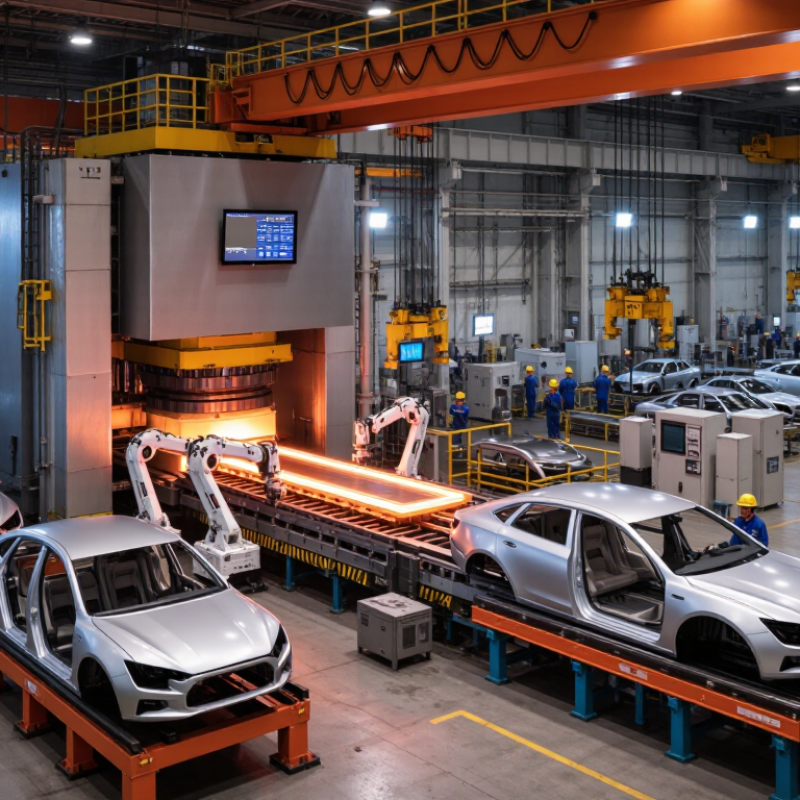
Automotive Stamping Tooling: Die Types, Processes, and 600–1,500 MPa Steel Grades
Automotive stamping tools turn flat steel blanks into panels, brackets, and structural parts. Progressive dies perform several operations as the strip advances through stations. Transfer dies move separate blanks between operations, while tandem lines use individual presses for larger parts. Each setup brings different trade-offs in output, part size, and adjustment time. Details matter.
Common operations include blanking, drawing, piercing, trimming, and flanging. Steel grades around 600–1,500 MPa require careful attention to forming limits, springback, and tool wear. Lower-strength grades may suit conventional cold stamping. At the upper end, material and part design can call for specialized forming methods, including hot stamping. A tight corner radius or poorly placed feature can raise cracking risk. It is easy to focus on press capacity and overlook these details.
Tips: Confirm the exact grade and thickness before finalizing die geometry. Trial parts should be checked for springback and edge quality. Keep a few measurements under review; early assumptions are not always right.

Representative tensile-strength levels for selected advanced high-strength steel (AHSS) grades used in automotive stampings.
Grade numbers indicate nominal strength classes; actual properties vary by product specification and supplier. Higher-strength steels generally require greater forming loads and careful control of die geometry, material flow, and tool wear. Common tooling approaches include progressive, transfer, and tandem dies, selected according to part design and production needs.
A stamping die converts flat sheet metal into parts that must fit together within tight tolerances. Body panels need clean edges and controlled curves; a small springback error can leave a door gap visibly uneven. Chassis brackets and crossmembers face different demands, including load paths, hole alignment, and repeatable strength. Structural pillars and rails may use high-strength steel, which can resist deformation but also complicate forming. The die design must account for material flow, press force, lubrication, and tool wear. Small details matter.
The production scale is substantial: OICA reported 93.5 million motor vehicles produced worldwide in 2023. Meanwhile, the IEA’s Global EV Outlook 2024 recorded nearly 14 million electric car sales in 2023, about 18% of global car sales. These figures point to a broad, changing mix of vehicle structures, not one universal die design. Very practical work. A die that performs well in simulation may still need adjustment after tryout, when wrinkles or springback appear in actual parts. That gap deserves attention: reliable stamping depends on careful testing, maintenance, and process control, not tooling geometry alone.
Industry overview of ten common automotive stamping die types and their applications. This is a tooling-category comparison, not a ranked list of manufacturers.
| No. | Stamping Tooling Type | How It Works | Typical Automotive Applications | Common Production Fit |
|---|---|---|---|---|
| 1 | Progressive Die | A coil-fed strip advances through successive stations, with operations such as piercing, forming, and cut-off performed in sequence. | Brackets, clips, reinforcement pieces, and other relatively small components. | High-volume production of repeatable parts. |
| 2 | Transfer Die | A blank or partly formed workpiece is moved between separate stations, where successive forming and trimming operations take place. | Deeper or larger parts, including selected structural and chassis components. | Multi-operation parts that need access around the workpiece between stations. |
| 3 | Tandem Line Dies | A sequence of dies in separate presses performs successive operations, with parts transferred from press to press. | Large body panels such as doors, hoods, and fenders. | Large parts and production programs requiring flexible die changes. |
| 4 | Drawing Die | A punch and die shape flat sheet metal into a three-dimensional form while controlling material flow. | Door inners, floor pans, wheelhouses, and other formed panels. | Parts with depth or curved surfaces that cannot be made by flat blanking alone. |
| 5 | Blanking Die | Cuts a flat component blank from sheet or coil stock; the blank becomes the workpiece for later operations or a finished flat part. | Panel blanks, reinforcement blanks, and flat components. | Preparing accurately shaped blanks for downstream forming. |
| 6 | Trimming Die | Removes excess material from a formed part to establish its required edge or contour. | Drawn body panels, housings, and formed structural parts. | Finishing part outlines after forming operations. |
| 7 | Piercing Die | Punches holes or slots in sheet metal; removed material is scrap rather than the finished part. | Mounting holes, fastener openings, and access features in panels and brackets. | Parts requiring accurately located openings for assembly or function. |
| 8 | Flanging Die | Bends an edge of the sheet metal to create a flange for stiffness, joining, or assembly. | Body-panel edges, brackets, and structural part features. | Adding formed edges after blanking or drawing. |
| 9 | Restrike Die | Re-forms a previously shaped part to improve contour, dimensional consistency, or surface definition. | Visible body panels and formed components with critical dimensional requirements. | Secondary correction or calibration after major forming operations. |
| 10 | Hot-Stamping Die | Forms heated, hardenable steel sheet and cools it in the die as part of a press-hardening process. | Selected safety-critical structural parts, including reinforcements and pillars. | Components designed to combine complex formed geometry with high strength. |
Comparing manufacturers takes more than a brochure’s accuracy claims. Ask for inspection records from comparable parts, including hole positions, flange angles, and springback after forming. A sample panel that fits once is useful; repeatability across a production run matters more. Check how the supplier measures critical features and handles corrections after a tool tryout. Small deviations can create costly fit-up problems downstream.
Tips: Compare press capacity, bed size, and material range against your actual part requirements. Request a milestone schedule covering design approval, tool build, tryout, and delivery. Clarify what happens when samples miss specifications. A quoted lead time may exclude design changes or shipping, so ask what assumptions it depends on.
Global support deserves a practical test. Confirm time-zone coverage, language options, spare-part availability, and response expectations during production interruptions. Ask who will troubleshoot a tool at your plant, and whether remote support includes usable setup instructions. Compare the same scope across manufacturers; otherwise, a lower quote may simply omit engineering or service. Even a neat scorecard can miss shop-floor realities. I would treat it as a starting point, then verify claims with references and a technical review of the proposed process.
The leading automotive stamping-tooling manufacturers are concentrated in East Asia, Europe, and North America, close to major vehicle plants. OICA reported 93.5 million vehicles produced worldwide in 2023. That scale rewards suppliers able to build large transfer dies, progressive dies, and precision blanking tools. East Asian manufacturers often serve dense production networks and high-volume programs. European firms are known for complex body structures and close engineering collaboration. North American suppliers support large panels, pickup platforms, and regional production lines. Regional labels are not guarantees.
Capabilities now extend beyond cutting steel. Top-tier toolmakers use simulation, high-speed machining, and tryout presses to reduce forming defects before production. They must also manage material springback, tight dimensional tolerances, and die maintenance across long production runs. The International Energy Agency reported nearly 14 million electric-car sales in 2023, about 18% of total car sales. This shift increases demand for tooling suited to battery housings and lighter body structures. Details vary by platform.
Buyers should compare engineering support, tool-transfer experience, spare-part lead times, and proximity to assembly plants—not price alone. A supplier may deliver an excellent die, yet struggle to support a distant factory during a production change. That picture is incomplete: public rankings rarely disclose comparable data on defect rates, delivery performance, or lifetime tooling cost.
Worldwide vehicle production reached 93.5 million units in 2023, according to OICA. That figure gives automotive stamping toolmakers a useful measure of industrial scale. It is not a direct count of stamping dies, however. Vehicle designs use different body structures, materials, and production routes. Still, many high-volume platforms depend on precisely formed metal parts, from outer panels to structural reinforcements. On a plant floor, the connection is tangible: press lines feed sheet metal through tools that must deliver consistent shapes at production speed. Small deviations matter.
The headline also needs context. The total combines passenger cars and commercial vehicles, while production is distributed unevenly across regions. Changes in model mix or plant utilization can shift tooling requirements even when global volume looks stable. Capacity planning cannot rely on one annual number alone. Tool life, changeover time, material grades, and repair access all affect costs. The 93.5-million-unit market is substantial, but not simple. It can guide an initial estimate; it cannot replace plant-level data.
Fill out the form below and our team will get back to you ASAP.
Snake Tray® is Green and Proudly Powered by the Sun! Snake Tray is committed to designing and manufacturing products that have many green benefits. Our products are made of recycled goods, minimize material waste, are energy efficient, use less non-renewable resources and nest together read more…
Snake Tray® 291 Skip Lane, Bay Shore NY 11706 | PHONE: 631-674-0004 | FAX: 631-674-0010 | www.bakoselectric.com | LEGAL | MADE IN USA
© 2025 SnakeTray. All rights reserved
Fill out the form below to download your document.