Choosing Moulded Case Circuit Breakers is not just a matter of matching an ampere rating. The right device must suit the circuit, the expected fault current, and the conditions inside the enclosure. A breaker selected without checking these details may trip too often—or fail to provide the intended protection. Details matter.
This guide presents ten practical tips for comparing breakers before purchase or installation. It explains how to review rated current, voltage, interrupting capacity, trip characteristics, pole configuration, and coordination with upstream and downstream devices. It also considers ambient temperature, available panel space, terminal compatibility, and access for inspection. Each factor can affect performance in a real installation. A neat specification sheet can still hide a poor fit.
Reliable selection starts with the equipment manufacturer’s documentation and the system’s design requirements. Where calculations, coordination studies, or local installation rules apply, qualified electrical professionals should verify the choice. Product labels and online listings alone may not show how a breaker behaves under the site’s actual conditions. That is worth remembering. The ten tips that follow are intended to make comparisons clearer, highlight questions to ask suppliers, and reduce avoidable mismatches. They are not a substitute for engineering review. Even experienced buyers can overlook one small detail, such as a terminal limitation or a temperature-related rating adjustment. A careful check is usually faster than correcting the wrong selection later.
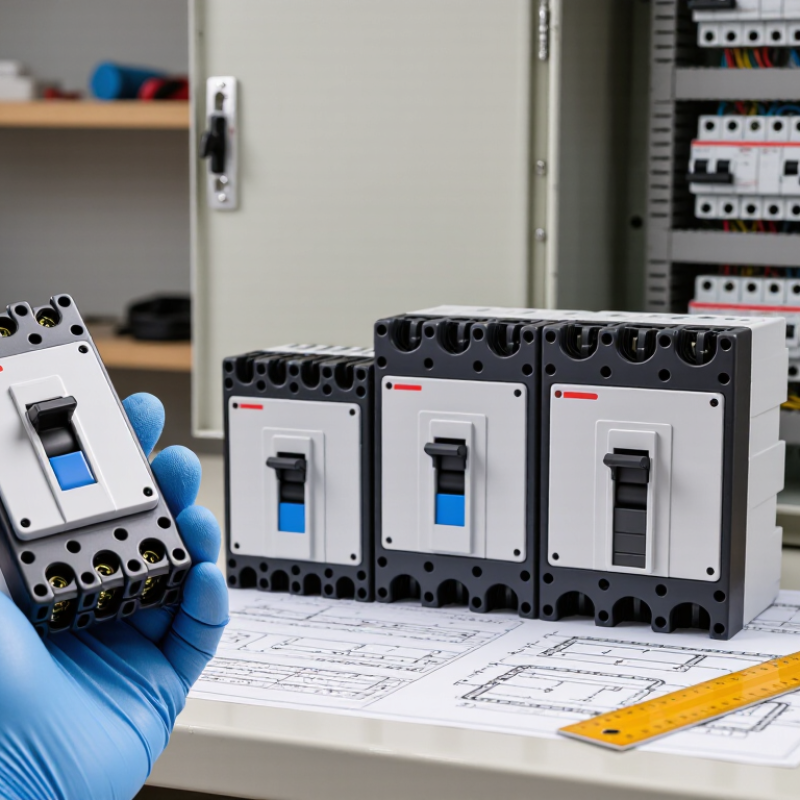
Moulded case circuit breakers (MCCBs) protect electrical circuits from excessive current caused by overloads or short circuits. They interrupt current before overheating damages cables, equipment, or connected loads. Their role is practical: limit fault damage and help keep an installation operating safely. They are commonly installed in distribution boards and control panels.
MCCBs suit circuits carrying more current than many miniature breakers can handle. You may find them protecting building feeders, workshop machinery, pumps, and motor circuits. Some models offer adjustable trip settings, which can help match protection to the cable and load. That matters. A breaker set too high may not protect its cable adequately; set too low, it may trip during normal operation.
Choosing one involves more than matching the current rating. Check the system voltage, available fault current, pole count, and the manufacturer’s trip characteristics. Confirm that the breaking capacity is suitable for the installation’s likely fault level. Coordination with upstream and downstream protection also matters, though it is sometimes overlooked. Not always. Real operating conditions can differ from a neat design sheet, so verify settings and installation details with a qualified electrical professional.
| No. | Selection Tip | What to Check | Practical Guidance |
|---|---|---|---|
| 1 | Define the circuit’s role | Identify whether the breaker protects a feeder, motor circuit, transformer, generator, or other load. | Consider normal operating current, inrush or starting current, and the characteristics of the connected equipment before choosing trip settings. |
| 2 | Match the current rating to the circuit | Check the load current, conductor ampacity, installation conditions, and applicable electrical codes. | Select a rating and settings that provide suitable overload protection without exceeding the permitted current for the conductors or equipment. |
| 3 | Verify voltage and frequency suitability | Confirm the breaker’s rated operational voltage, system type (AC or DC), and frequency are suitable for the application. | Use the ratings specified for the actual system. Do not assume an AC rating also applies to DC circuits. |
| 4 | Choose the required number of poles | Determine whether the circuit requires one-, two-, three-, or four-pole switching and protection. | Base the choice on the system configuration and local rules, including how neutral conductors must be treated. |
| 5 | Check short-circuit breaking capacity | Compare the prospective short-circuit current at the installation point with the breaker’s rated ultimate breaking capacity (Icu). | The breaker’s applicable breaking capacity must be adequate for the available fault current at its rated voltage. |
| 6 | Review service breaking capacity | Check the rated service short-circuit breaking capacity (Ics), where specified, as well as Icu. | Ics indicates the breaker’s ability to remain serviceable after specified short-circuit tests. Select a suitable value for the required continuity of service. |
| 7 | Select the appropriate trip unit | Compare thermal-magnetic and electronic trip options, available protection functions, and adjustment ranges. | Use settings suited to the load and protection study. Electronic trip units may offer adjustable protection and additional functions, depending on the model. |
| 8 | Assess coordination with other devices | Review time-current curves and coordination information for upstream and downstream protective devices. | Where continuity is important, verify selectivity or discrimination using the applicable manufacturer data and system fault levels. |
| 9 | Account for installation conditions | Check ambient temperature, enclosure conditions, altitude, mounting orientation, terminal limits, and available space. | Apply any specified derating or installation limits. Confirm that the enclosure and connections support safe heat dissipation and the required clearances. |
| 10 | Confirm standards and accessories | Check compliance with the standards required in the installation region, such as IEC 60947-2 or UL 489, as applicable. | Verify that accessories—such as auxiliary contacts, shunt trips, or undervoltage releases—are compatible and meet the control and monitoring requirements. |

Start with the system. Record its nominal voltage, phase, and grounding arrangement from equipment documentation and site measurements. A breaker’s voltage rating must meet or exceed the circuit voltage. For example, a 480-volt system needs a breaker rated for that voltage, not merely one with a suitable current rating.
Check the equipment nameplate, too. Small mismatch, big consequences.
Then determine the expected operating current from the actual load, not just a rough estimate. Consider continuous operation, startup surges, ambient temperature, and the enclosure, which can affect breaker performance.
The interrupting capacity must also be high enough to safely clear the prospective short-circuit current at the installation point. That value depends on the supply and circuit details, so have it calculated or verified by a qualified professional.
One detail is easy to miss: a rating that works near a small transformer may be inadequate closer to a powerful supply. Confirm that the selected breaker coordinates appropriately with upstream and downstream protection.
A careful check now can prevent a costly mismatch later.
When choosing a moulded case circuit breaker, match its trip unit to the load, fault level, and required coordination. A thermal-magnetic unit may suit a straightforward feeder. Electronic units offer adjustable long-time, short-time, and instantaneous settings, with ground-fault protection available on some models. Each function should address a real system need; extra settings can create confusion if they are not documented.
Use a coordination study to check that the breaker closest to a fault trips before upstream devices. Confirm the available fault current, conductor limits, motor starting current, and the manufacturer’s trip curves. Ground-fault protection can help detect leakage, but its pickup and delay need careful setting to avoid nuisance trips. Small details matter. The U.S. Bureau of Labor Statistics reported 145 fatal work injuries from exposure to electricity in 2022 in its Census of Fatal Occupational Injuries. That figure does not show that breaker selection alone prevents incidents, but it underscores why protection settings deserve qualified review. Record the final settings and verify them during commissioning; in practice, one assumption about startup current can require a second look.
This chart compares typical protection functions: 1 indicates that a function is commonly available, and 0 indicates that it is not typically included. Electronic trip-unit features vary by model; confirm the required long-time, short-time, instantaneous, and ground-fault protection against the manufacturer’s specifications and the installation’s coordination study.
Choosing a moulded case circuit breaker starts with the installation, not the catalogue page. Check the system voltage, continuous load, prospective short-circuit current, and available fault level. Measure twice. Ambient temperature matters, especially inside a crowded panel where heat can reduce carrying capacity. Altitude, humidity, dust, vibration, and enclosure protection also affect reliable operation.
Use the standard required for the installation. IEC 60947-2 and UL 489 define different testing and marking expectations, so approval should match the project location and equipment design. Confirm interrupting capacity at the actual voltage, not only the maximum value shown in a table.
A breaker may fit physically yet fail the thermal conditions. Check the heat.
Coordination with upstream and downstream devices deserves careful review. Compare time-current curves, instantaneous settings, cable withstand limits, and available fault current. Selective coordination can keep a small feeder fault from shutting down an entire panel. For motor circuits, consider starting current and repeated acceleration. For emergency systems, verify short-circuit ratings and documented settings with a qualified engineer. I have seen selections based only on rated current; that approach is quick, but often incomplete. Installation records, test results, and adjustment seals help preserve the intended protection after commissioning. Leave room for field reality. Fault studies may change when transformers, generators, or long cable runs are added.
Choosing a moulded case circuit breaker requires more than comparing catalogue prices. Verify compliance with IEC 60947-2, rated service short-circuit capacity, temperature performance, and documented type-test results. A higher-quality breaker should provide consistent trip accuracy after repeated operations. Tip: Check the test certificate, not only the product label. Also inspect terminal strength, enclosure fit, and the availability of replacement accessories.
Maintenance affects the real purchase cost. NFPA 70B:2023 provides a recognized framework for documented electrical maintenance, including inspection, testing, and service records. Choose breakers with accessible trip settings, clear status indicators, and replaceable auxiliary contacts. Record tightening torque and thermal-scan results during scheduled inspections. Poor access can turn a simple inspection into several hours of downtime. Tip: Compare the five-year cost of testing, spares, labour, and shutdowns. A cheap breaker may become expensive after one failure.
Safety features deserve practical attention. Adjustable thermal and magnetic protection can support accurate coordination, while undervoltage releases, shunt trips, and lockable handles improve isolation procedures. Select interrupting capacity above the calculated fault level, with suitable margin. ESFI’s 2023 workplace data recorded 126 electrical fatalities and 2,360 non-fatal electrical injuries from 2011 to 2022. That evidence makes verification important. Tip: Review fault calculations, arc-flash boundaries, and installer training together. No selection method is perfect. Field conditions, ageing cables, and incorrect settings can defeat a well-specified breaker.
Fill out the form below and our team will get back to you ASAP.
Snake Tray® is Green and Proudly Powered by the Sun! Snake Tray is committed to designing and manufacturing products that have many green benefits. Our products are made of recycled goods, minimize material waste, are energy efficient, use less non-renewable resources and nest together read more…
Snake Tray® 291 Skip Lane, Bay Shore NY 11706 | PHONE: 631-674-0004 | FAX: 631-674-0010 | www.bakoselectric.com | LEGAL | MADE IN USA
© 2025 SnakeTray. All rights reserved
Fill out the form below to download your document.