An Rcc Pole Making Machine is used to manufacture reinforced concrete poles for power distribution, street lighting, and related infrastructure. It helps shape concrete around a steel reinforcement cage, producing poles with a defined length, diameter, and surface finish. Depending on the model, the equipment may use spinning, vibration, or another compaction method to reduce voids and help distribute concrete inside the mold.
The machine is part of a wider production process, not a complete solution on its own. Operators prepare the reinforcement cage, position it accurately, fill the mold, and follow suitable curing practices. Some systems include powered mold rotation, while others rely on different arrangements. Details vary by design and manufacturer. Check the specifications.
A properly selected machine can support repeatable production and reduce some manual handling. It may also help a plant meet demand for poles of different sizes, provided the molds and production settings are appropriate. Still, output quality depends on more than machinery. Concrete mix, cage placement, compaction, curing, and routine inspection all matter. A pole can look smooth and still need closer quality checks.
That is easy to overlook. Buyers should compare capacity, mold options, operating requirements, and maintenance support before choosing equipment. The right machine depends on the pole designs and production volume a facility actually needs. This guide explains what the equipment does, how it fits into pole manufacturing, and which practical factors deserve attention. A little caution helps.
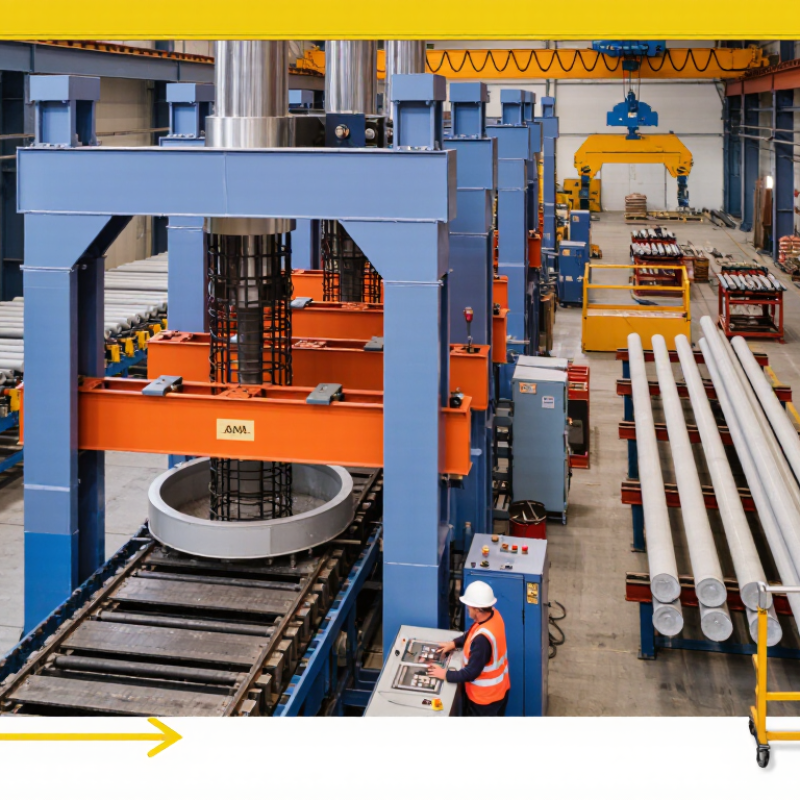
An RCC pole making machine is equipment used to shape reinforced cement concrete into poles for power distribution, street lighting, and related infrastructure. RCC means reinforced cement concrete: steel bars or a cage sit inside concrete to improve strength under bending and handling. Depending on the pole design, production may use spinning, vibration, or another compaction method. A typical setup includes a mold, reinforcement cage, concrete placement, compaction equipment, and curing space. A production system, not merely a mold.
The Global Cement and Concrete Association’s Concrete Future roadmap estimates that about 14 billion cubic metres of concrete are used worldwide each year. That scale makes controlled production important, but a machine alone cannot guarantee a sound pole. Mix consistency, cage position, compaction, and curing all affect quality. For spun-cast prestressed poles, ASTM C1089 provides a relevant specification; it should not be treated as a universal requirement for every RCC pole. The details matter. Operators still need to check the actual design and applicable project criteria. A small alignment error can be hard to spot until demolding, which is one reason production records and inspections deserve attention.

What Is an RCC Pole Making Machine Used For?
How the Machine Forms Reinforced Concrete Poles
An RCC pole making machine shapes concrete around a steel reinforcement cage to produce a strong, consistent pole. The cage is positioned inside a long, rigid mold, with spacers helping maintain concrete cover. Workers or automated equipment feed a measured concrete mix into the mold. Then comes spinning. Centrifugal force pushes the mix outward against the mold wall, compacting it and helping reduce air pockets. The exact speed and duration depend on the pole design and mix; one setting does not suit every production line.
After spinning, the pole remains in its mold while the concrete gains strength under controlled curing conditions. The mold is then opened, and the pole is checked for dimensions, visible defects, and structural quality. EN 12843 covers precast concrete masts and poles, providing a useful reference for product requirements. The GCCA’s 2021 Concrete Future report estimates that the world uses about 14 billion cubic metres of concrete each year. At that scale, consistent mixing and compaction matter. Still, speed can tempt operators to shorten curing or inspection; that trade-off deserves scrutiny, since a smooth surface alone cannot confirm a reliable pole.
| Production Stage | Machine or Operation | What Happens | Key Materials or Controls | Result |
|---|---|---|---|---|
| Reinforcement preparation | Rebar cutting, bending, and cage assembly | Steel bars and ties are arranged into a reinforcement cage to suit the pole design. | Bar size, spacing, cage length, and specified concrete cover | A steel cage that helps the finished pole resist bending and handling loads |
| Mold preparation | Reusable pole mold and end fittings | The mold is cleaned, assembled, and prepared to form the pole’s shape and openings. | Mold dimensions, alignment, release agent, and embedded fittings where specified | A prepared cavity for casting the pole |
| Cage placement | Cage positioning in the mold | The reinforcement cage is placed and supported inside the mold so it remains in the intended position during casting. | Positioning supports, cover, and clearance from the mold wall | Reinforcement held in place within the pole profile |
| Concrete placement | Concrete batching and mold filling | Fresh concrete is placed around the cage, with the mix distributed along the mold. | Approved mix proportions, workability, aggregate grading, and consistent filling | A filled mold containing concrete and reinforcement |
| Compaction and forming | Spinning or centrifugal pole-forming machine | The mold rotates at controlled stages. Centrifugal action distributes and compacts the concrete against the mold wall; excess water may be expelled, depending on the process and mix. | Rotation sequence, operating speed, cycle time, mold balance, and concrete consistency | A compacted pole body formed to the mold’s dimensions, commonly with a hollow core |
| Curing | Controlled curing area or curing system | The cast pole is kept under suitable curing conditions so the concrete can gain strength. The curing method and duration depend on the mix and production specification. | Temperature, moisture, curing method, and required strength before handling | Concrete that has developed sufficient strength for demolding and subsequent handling |
| Demolding and inspection | Mold opening, pole handling, and quality checks | Once the pole is strong enough, the mold is opened and the pole is inspected for dimensions, surface condition, and visible defects. | Safe lifting points, dimensional tolerances, appearance, and applicable project requirements | A demolded pole ready for further curing, testing, or storage |
| Typical application | Finished reinforced concrete pole | RCC poles are used where a designed concrete pole is required, such as for certain overhead distribution lines, lighting, or other utility structures. | Pole design, load requirements, local standards, and installation conditions | A pole intended for its specified structural and service conditions |
An RCC pole making machine forms reinforced concrete poles by holding a steel mold and rotating it to distribute and compact the concrete. The mold determines the pole’s length, taper, and outer shape. Its clamps must secure the halves firmly; loose connections can cause leakage or uneven surfaces.
The drive motor and gearbox turn the mold at controlled speeds. Bearings support the rotating assembly and help limit vibration. Speed matters. Too little rotation may leave concrete poorly distributed, while excessive or uneven rotation can affect compaction. A control panel lets operators adjust the cycle and monitor the drive. Guards and emergency stops reduce exposure to moving parts, but they still need regular inspection.
A reinforcement cage sits inside the mold, positioned to maintain concrete cover around the steel bars. Some production setups include a tensioning system for prestressed poles; its purpose and operating requirements depend on the pole design. Concrete is placed into the mold before spinning, then the filled mold is removed or moved for curing. In practice, mold alignment is easy to underestimate. Even a small mismatch can leave a visible seam or inconsistent wall thickness, so operators check the mold and cage before each run.
What Is an RCC Pole Making Machine Used For?
Common Uses of RCC Poles
An RCC pole making machine produces reinforced concrete poles for carrying essential services above ground. Power utilities commonly install these poles along roads and village routes for low- and medium-voltage distribution. Steel reinforcement helps each pole resist bending from wind and conductor tension. Pole dimensions and strength must match the line’s load and local ground conditions. That matters. An undersized pole may crack or lean, even when its surface looks sound. Crews also use RCC poles for streetlights, where height and mounting details affect how well roads and footpaths are lit.
Telecommunications networks use RCC poles to support overhead telephone and fiber-optic cables, especially where underground installation is impractical. In rural areas, poles can extend electricity and communications across farmland. Some sites also use them for signs or perimeter lighting, though these applications may need different fittings. RCC resists rot and many pests, but concrete poles are heavy to transport and replace. Not everywhere. Coastal salt, aggressive soil, poor curing, or careless lifting can shorten a pole’s service life. Maintenance teams should check for cracks, exposed steel, leaning, and footing damage. It is easy to assume concrete means maintenance-free; it does not.
An RCC pole making machine shapes reinforced concrete around a steel cage, producing poles for power lines, lighting, or other infrastructure. Its rated output matters, but capacity is not just the number of poles made per shift. Mold dimensions, pole length, concrete-setting time, and handling space all affect production. A long mold may increase output per cycle, yet it also needs suitable lifting equipment and room for safe movement.
Pole quality depends on consistent vibration, accurate reinforcement placement, and a workable concrete mix. If vibration is too weak, voids can remain around the steel bars. Too much vibration may separate the mix. Small details matter. The cage must stay centered, and concrete should fill narrow sections without leaving gaps. Curing conditions also count: uneven moisture or rushed demolding can lead to cracks or reduced strength.
Machine capacity should match the whole production line, not just the forming stage. A fast cycle offers little benefit if workers cannot prepare cages or move finished poles at the same pace. Routine checks on molds, vibration components, and alignment help keep results consistent. Still, no machine removes every source of variation; aggregate moisture and operator adjustments can change a batch. That part is easy to underestimate. A practical capacity estimate should include setup, cleaning, curing, and occasional downtime, rather than relying only on the machine’s best-case cycle time.
An RCC pole making machine forms reinforced-concrete poles, commonly using a rotating mold to compact the concrete. This chart shows theoretical output for one mold, assuming one pole per cycle and a fully productive eight-hour shift: output is calculated as 480 minutes divided by cycle time. The cycle-time scenarios are illustrative, not universal machine specifications; actual production is lower when setup, loading, unloading, changeovers, or downtime are included. Pole quality also depends on concrete mix and compaction, reinforcement placement, mold alignment, and proper curing.
Fill out the form below and our team will get back to you ASAP.
Snake Tray® is Green and Proudly Powered by the Sun! Snake Tray is committed to designing and manufacturing products that have many green benefits. Our products are made of recycled goods, minimize material waste, are energy efficient, use less non-renewable resources and nest together read more…
Snake Tray® 291 Skip Lane, Bay Shore NY 11706 | PHONE: 631-674-0004 | FAX: 631-674-0010 | www.bakoselectric.com | LEGAL | MADE IN USA
© 2025 SnakeTray. All rights reserved
Fill out the form below to download your document.