Choosing an Electrostatic Collector begins with the particles you need to capture, not the product label. Fine dust, cooking aerosols, and industrial process emissions place different demands on a collector. Airflow, particle size, operating hours, and available maintenance time all affect performance. A unit that looks powerful on paper may disappoint if its capacity does not match the actual air volume. Fit matters.
The U.S. Environmental Protection Agency’s Air Pollution Control Technology Fact Sheet for electrostatic precipitators reports collection efficiencies above 99% in suitable industrial applications. That figure is not a universal promise: results depend on particle properties, system design, and operating conditions. The World Health Organization’s 2022 air-quality update also reported that 99% of the global population lived in areas exceeding its air-quality guideline levels. These findings underline why particle control deserves careful attention, but they do not replace application-specific testing.
Before comparing models, check rated airflow, collection efficiency, pressure drop, cleaning requirements, and any ozone information supplied by the manufacturer. Ask how performance was measured and whether the test conditions resemble your site. For example, a busy workshop with visible dust may need a different configuration from a quiet room with fine airborne particles. Not every collector suits every space. I would also leave room for doubt: published ratings can simplify real operating conditions, so verify them with a qualified supplier and measured site data.
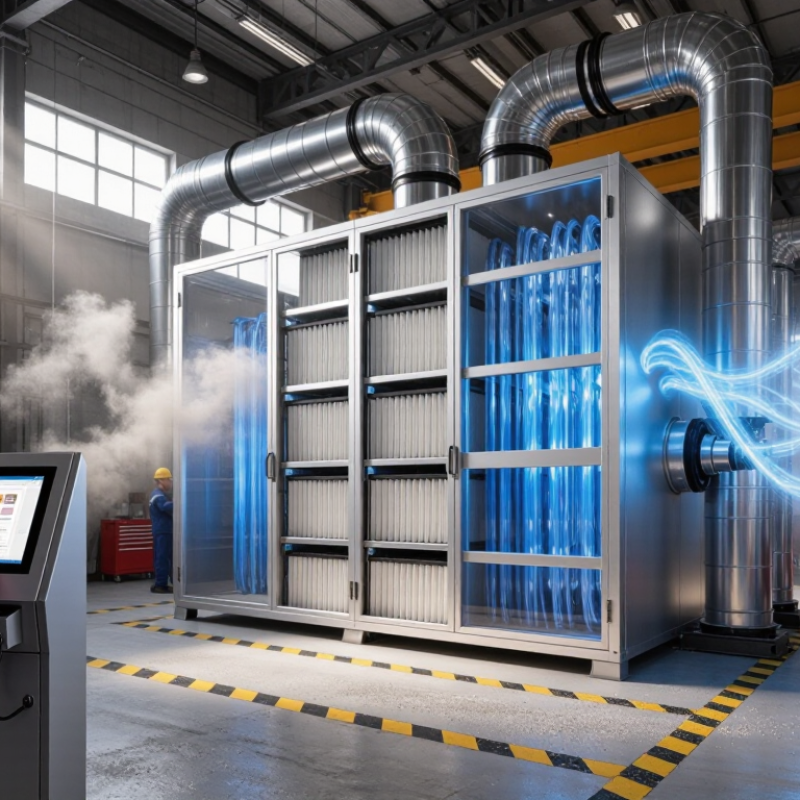
Before choosing an electrostatic collector, determine how much air the system must handle during real production. Measure airflow at the pickup points, and note which machines operate at the same time. A fan’s rated capacity alone may not reflect the flow reaching the collector. Long ducts, bends, filters, and leaks can change it. Small details matter.
Record the highest expected airflow, not just a quiet shift’s average. Then define what “clean enough” means for your process. Consider particle size, dust concentration, and the share of particles you need removed. Fine particles may behave differently from larger, heavier dust. Visible air is not a reliable measurement. Ask a qualified technician to assess the air where it is generated and, when needed, test particle levels.
Also check operating temperature, humidity, and changes in dust loading. These conditions can affect collection performance and maintenance needs. Treat initial readings as provisional: production patterns change, and one measurement may miss a busy period. Recheck the numbers after installation, especially if airflow feels weak at a pickup hood or dust escapes during operation. A collector selected around actual flow and a clear removal target is easier to evaluate than one chosen by appearance or a rough guess.

An electrostatic collector removes airborne particles by giving them an electrical charge. In many designs, a high-voltage section creates ions that attach to dust, smoke, or droplets. The charged particles then move through an electric field toward oppositely charged plates. They stick there instead of continuing with the airflow. That matters.
Capture is not the same as destruction: particles usually remain on collection surfaces until cleaning. A thin gray film on the plates is a visible sign of use, not proof of high efficiency. Air speed, particle size, and plate condition all affect how much material gets captured. Excessive airflow can carry particles through too quickly; dirty plates can weaken collection. Not magic.
When choosing a unit, match its rated airflow to the room or process it must serve. Check how it handles different particle sizes and how often its plates need washing. Ask about ozone emissions and maintenance, since ionizing designs and operating conditions vary. If possible, compare particle measurements before and after installation under normal operating conditions. Real performance can be less tidy than a product rating suggests.
Understand How Electrostatic Collectors Capture Particles
Electrostatic collectors charge airborne particles and attract them to oppositely charged collection plates. This illustrative profile shows a possible efficiency pattern across particle sizes; actual performance depends on collector design, particle properties, gas conditions, and operating settings. Use site-specific test data when selecting equipment.
How to Choose an Electrostatic Collector
Compare Collector Types and Filtration Performance
An electrostatic precipitator charges airborne particles, then draws them onto grounded collection plates. The U.S. EPA’s Air Pollution Control Technology Fact Sheet for Electrostatic Precipitators reports typical collection efficiencies of 99% to 99.9%. That figure is useful, but not a guarantee. Particle resistivity, gas temperature, and changes in operating conditions can affect real-world performance. Look beyond the headline percentage.
Fabric filters capture particles as gas passes through filter bags. The EPA’s fact sheet on fabric filters also reports efficiencies above 99%, so both technologies can perform strongly. An electrostatic collector avoids routine bag replacement and often has lower pressure drop, but its plates need inspection and cleaning. A baghouse can offer dependable fine-particle capture, though filter wear and pressure drop require attention. Small details matter. Compare performance at your actual airflow and dust loading, not only at a supplier’s ideal test conditions. Ask for test data, operating history, and maintenance requirements. Even then, predictions can miss something: dust properties may shift, and a tidy efficiency number cannot show every upset in a real plant.
Choosing an electrostatic collector starts with the actual gas stream, not a catalog estimate. Measure flow rate, temperature, moisture, particle loading, and dust resistivity across normal and peak conditions. The U.S. EPA’s Air Pollution Control Technology Fact Sheet reports collection efficiencies of 99% or higher for electrostatic precipitators, but that figure is not a promise for every installation. Small details matter. Dust chemistry can shift performance.
Sizing should reflect the required airflow and particle behavior. The EPA’s Air Pollution Control Cost Manual discusses specific collection area and particle properties as important design factors. Ask for the assumptions behind the proposed area and efficiency, including how changing flow affects performance. A neat spreadsheet can still miss a production shift or a dusty startup. Check the numbers against site measurements.
Installation affects the result, too. Uneven gas distribution, air leaks, or poorly aligned collection plates can reduce effective treatment. Leave safe access for inspection and cleaning, and confirm the power supply matches the collector’s electrical sections. During operation, track voltage, current, pressure drop, and outlet dust levels. Compare readings over time, not just during commissioning. Not on paper. In practice, operators may find one condition was overlooked; record it, investigate, and adjust the operating plan. Sources: U.S. EPA, Air Pollution Control Technology Fact Sheet: Electrostatic Precipitators (ESP), EPA-452/F-03-027; Air Pollution Control Cost Manual.
How to Choose an Electrostatic Collector
Assess Maintenance Needs and Total Ownership Costs
Before choosing an electrostatic collector, map out the work required to keep it operating. Check how often collection plates, discharge components, and prefilters need inspection or cleaning. Ask whether technicians can reach these parts safely without dismantling nearby equipment. Small details matter. A narrow service aisle can turn a routine cleaning into a lengthy shutdown.
Request a maintenance schedule and price common replacement parts, not just the initial purchase. Include labor, cleaning supplies, energy use, and expected downtime in your cost estimate. If the unit serves a busy production line, even a few hours offline may affect output. Confirm what training your staff will need and whether specialized tools are required. A spreadsheet can still miss costs when service access or staffing changes.
Compare these estimates across several years, using realistic operating hours and local labor rates. Ask suppliers to explain assumptions behind claimed service intervals; dust type and loading can change actual maintenance needs. Keep room in the budget for unexpected repairs. That estimate may be imperfect. Review the plan with the people who will inspect and clean the equipment, since they often spot practical obstacles that a specification sheet overlooks.
Fill out the form below and our team will get back to you ASAP.
Snake Tray® is Green and Proudly Powered by the Sun! Snake Tray is committed to designing and manufacturing products that have many green benefits. Our products are made of recycled goods, minimize material waste, are energy efficient, use less non-renewable resources and nest together read more…
Snake Tray® 291 Skip Lane, Bay Shore NY 11706 | PHONE: 631-674-0004 | FAX: 631-674-0010 | www.bakoselectric.com | LEGAL | MADE IN USA
© 2025 SnakeTray. All rights reserved
Fill out the form below to download your document.