A power outage can turn a quiet kitchen into a food-safety problem within hours. Many homeowners ask, “how long can a fridge last without power?” The practical answer depends on room temperature, insulation, food volume, and how often the door opens. A well-stocked, unopened refrigerator usually keeps food cold for about four hours, according to widely accepted food-safety guidance.
It feels longer in winter. It becomes risky faster during a hot summer afternoon. A modern China Top Fridge may include strong insulation, inverter cooling, or smart temperature alerts. However, these features cannot preserve safe temperatures forever. An unopened full freezer can often remain cold for approximately 48 hours, while a half-full freezer may last around 24 hours. These figures are estimates, not promises.
During an outage, keep the doors closed and check the temperature with a food thermometer when power returns. Perishable food should remain at or below 4°C (40°F). If meat, seafood, dairy, or cooked leftovers feel warm for too long, discarding them may be safer than relying on smell. Smell can mislead you. I have found that people often remember the outage duration but forget earlier door openings. That detail changes the calculation. This guide examines insulation, refrigerator size, room conditions, food placement, and safe recovery steps, while recognizing that every appliance and outage behaves differently. Sometimes, the simplest decision is the most reliable one: when in doubt, throw it out.
China Top Fridge: How Long Can a Fridge Last Without Power?
A refrigerator does not lose cold at one fixed rate. USDA Food Safety and Inspection Service guidance says an unopened refrigerator stays cold for about four hours during an outage. FDA guidance sets 40°F (4°C) as the safety limit for chilled food. These figures help, but they are not promises.
Door opening changes everything. Each opening lets warm, humid air enter while cold air escapes around the gasket. A packed cabinet usually holds temperature longer than an almost empty one. Cold food acts like stored ice. Room temperature also matters. A shaded kitchen may outperform a refrigerator beside a sunny window. A damaged or poorly sealed door shortens the cooling time sharply.
Keep the door closed. Very important. Before an outage, set the refrigerator near 37°F (3°C), without freezing fresh food. Place a separate thermometer on the middle shelf, because the display may measure air inaccurately. USDA data also indicates that a full freezer can remain safe for roughly 48 hours, while a half-full freezer lasts about 24 hours. Do not judge safety by smell; unsafe food may look normal. I would treat four hours as a planning limit, not a target. Real homes vary, and that uncertainty matters. A cheap thermometer beats guessing.
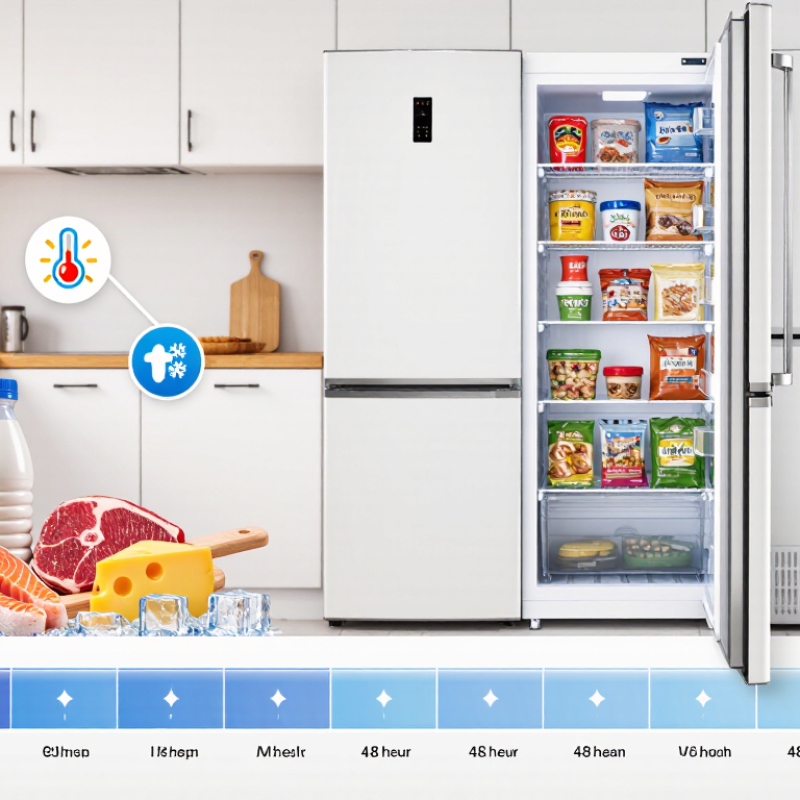
When a refrigerator loses power, keep the door closed. An unopened fridge usually keeps perishable food safe for about four hours. The exact time depends on room temperature, how full it is, and how often the door was opened.
Use a refrigerator thermometer if available. Food should remain at 4°C or below. After four hours, discard meat, seafood, eggs, milk, soft cheese, cooked dishes, and cut fruit if they feel warm. Do not taste food to check safety. Harmful bacteria may grow without changing its smell, color, or texture. That is an easy mistake to make.
A packed refrigerator stays cold longer than an almost empty one. You can place sealed ice packs inside, but avoid opening the door repeatedly. If the outage may last overnight, move high-risk food to a clean cooler with enough ice. Keep raw meat sealed and separate from ready-to-eat food. Frozen items may remain safe longer, especially in a full freezer, but a refrigerator compartment needs stricter attention. Four hours is a guide, not a guarantee. A very hot kitchen can shorten it. When uncertain, throw the food away; it is frustrating, but replacing groceries costs less than treating foodborne illness.
How long food remains safe depends on the appliance and temperature. An unopened refrigerator generally keeps perishable food safe for up to 4 hours without power. A full freezer can hold a safe temperature for about 48 hours, while a half-full freezer may last about 24 hours.
Food safety note: Discard refrigerated perishable food that has been above 40°F (4°C) for more than 4 hours. Keep the doors closed during an outage, and never taste food to determine whether it is safe.
A closed, fully stocked freezer usually keeps food frozen for about 48 hours. A half-full freezer may hold a safe temperature for nearly 24 hours. These estimates depend on room temperature, insulation, and how often the door opens. Keep the freezer shut. Every opening releases cold air quickly. Place a refrigerator thermometer inside, if available. Frozen food should remain at 0°F (-18°C) or below. After the power returns, check texture, temperature, and packaging. Food with ice crystals can often be refrozen, although its quality may decline. Soft or leaking packages need closer attention.
Tips: Move food together to preserve cold air. Add sealed ice packs or frozen containers of water. Do not taste food to test safety. If meat, seafood, eggs, or prepared meals stayed above 40°F (4°C) for over two hours, discard them. In a hot room, one hour is the safer limit. Dry ice can extend freezing time, but it needs ventilation and careful handling. Never place it directly against food without protection.
A refrigerator usually keeps food cold for about four hours without power. That window feels short, but it matters. Record the outage time before opening the door. When uncertain, choose safety over saving a meal. I have found that people often trust appearance too much; smell and color cannot reliably reveal harmful bacteria. Temperature records are more dependable.
A closed refrigerator usually keeps food cold for about four hours. The exact time depends on room temperature, insulation, and how often you open the door. Keep the door shut. Every opening releases valuable cold air. A full freezer can stay frozen for about 48 hours, while a half-full freezer may last around 24 hours. Use an appliance thermometer if possible. Guessing is risky.
When power fails, move meat, seafood, milk, and cooked dishes into a cooler with plenty of ice. Keep the food at 4°C or below. Store raw meat in sealed containers, away from ready-to-eat items. Check frozen food for ice crystals or a temperature below 4°C. Never taste food to test its safety. Smell can mislead you. Discard food that stayed warm too long, especially during hot weather.
Tips: Prepare two clean coolers before an outage. Freeze water bottles in advance. Record the outage time on paper. Avoid placing hot food inside the refrigerator. If food safety is uncertain, throw it away. This feels wasteful, but stomach illness costs more. A common mistake is trusting a cold-looking package without checking its actual temperature.
When a refrigerator loses power, food safety depends more on time and temperature than appearance. The U.S. Department of Agriculture reports that an unopened refrigerator keeps food cold for about four hours. A full freezer may hold a safe temperature for 48 hours, while a half-full freezer lasts about 24 hours.
Discard refrigerated meat, seafood, eggs, milk, and leftovers after two hours above 4°C (40°F). In rooms above 32°C (90°F), use one hour. The U.S. Food and Drug Administration warns that unsafe food may look and smell normal. Do not taste food to test it. That habit feels practical, but it is unreliable.
Watch for sour odors, slimy surfaces, leaking packages, swollen containers, or unusual color. These signs strongly suggest spoilage. Still, their absence proves nothing. Frozen food with ice crystals or a temperature below 4°C may be safely refrozen, although its texture can suffer. Soft ice cream, thawed seafood, and warm meat deserve extra caution. I have found that a small appliance thermometer gives better evidence than guessing from a cold shelf. Keep the door closed, record the outage time, and throw away uncertain food. Wasted food is frustrating. Food poisoning is worse.
Practical food-safety reference for refrigerator and freezer power outages
| Food Storage Area or Food Type | Safe Time or Temperature Guide | Discard When | Practical Safety Action |
|---|---|---|---|
| Closed refrigerator | About 4 hours, if the door remains closed | Perishable food held above 4°C (40°F) for 4 hours or more | Keep the door closed and use an appliance thermometer if available |
| Fully stocked freezer | Approximately 48 hours when kept closed | Food that has completely thawed and remained above 4°C (40°F) for 2 hours or more | Keep food tightly packed to retain cold air longer |
| Half-full freezer | Approximately 24 hours when kept closed | Food is fully thawed, warm, leaking, or has been above 4°C (40°F) too long | Move food to a working freezer or cooler with ice as soon as possible |
| Refrigerator temperature | Maintain at or below 4°C (40°F) | Discard high-risk food if the temperature cannot be verified and the outage exceeded the safe time | Use a food thermometer rather than relying on smell or appearance |
| Freezer temperature | 0°F (-18°C) or lower for long-term frozen storage | Discard food with an unusual odor, color, texture, or extensive leakage after thawing | Food that still contains ice crystals or is 4°C (40°F) or colder may generally be refrozen or cooked |
| Raw meat, poultry, seafood, and leftovers | High-risk perishable foods requiring continuous chilling | Discard if above 4°C (40°F) for 2 hours or more, or 1 hour when ambient temperature exceeds 32°C (90°F) | When in doubt, discard; do not taste food to test its safety |
| Milk, soft cheese, eggs, and prepared salads | Keep at or below 4°C (40°F) | Discard after unsafe time-temperature exposure, even if the food looks normal | Place these foods in a cooler with ice before less-sensitive items |
| Hard cheeses, butter, whole fruits, and vegetables | Generally less perishable than meat, seafood, dairy, and leftovers | Discard if mold, slime, fermentation, unusual odor, or visible spoilage appears | Keep separated from leaking raw meat and clean contaminated surfaces |
| Visible spoilage or damaged packaging | No safe extension based on appearance alone | Discard if packaging is swollen, leaking, punctured, badly damaged, or food has mold or an abnormal odor | Never sample questionable food; seal it before placing it in the waste container |
Fill out the form below and our team will get back to you ASAP.
Snake Tray® is Green and Proudly Powered by the Sun! Snake Tray is committed to designing and manufacturing products that have many green benefits. Our products are made of recycled goods, minimize material waste, are energy efficient, use less non-renewable resources and nest together read more…
Snake Tray® 291 Skip Lane, Bay Shore NY 11706 | PHONE: 631-674-0004 | FAX: 631-674-0010 | www.bakoselectric.com | LEGAL | MADE IN USA
© 2025 SnakeTray. All rights reserved
Fill out the form below to download your document.