How to Choose a Wire Winder in 2026?
Choosing a Wire Winder in 2026 requires more than comparing prices and advertised speed. The right machine should match your wire type, coil dimensions, production volume, and workplace conditions. A small workshop may need a compact benchtop model, while a cable manufacturer may require automated tension control and programmable winding patterns. These differences matter.
Start with the wire itself. Copper, aluminum, coated wire, and fine magnet wire respond differently to tension and bending. Check the recommended wire diameter range, spool capacity, winding width, and maximum rotation speed. Ask how accurately the machine controls tension during acceleration and stopping. Uneven tension can create loose layers, damaged insulation, or unstable coils. I have found that a slower, consistent winding process often produces better results than impressive maximum speed.
Safety and serviceability deserve equal attention. Look for guarded moving parts, emergency-stop access, clear operating instructions, and replaceable wear components. A reliable supplier should provide technical documentation, training, spare parts, and responsive support. Certification claims should be verified through credible documents, not copied marketing language. Be careful with vague promises.
Real operating conditions may expose weaknesses that a showroom demonstration hides. Test the Wire Winder with your actual material, spool, and target tension before making a final decision. Record noise, vibration, setup time, and coil quality. Leave room for doubt. Some requirements may change as production grows, so flexibility can be more valuable than a perfect specification today. This guide examines the practical factors that can help buyers choose confidently, while acknowledging that no single machine suits every application.
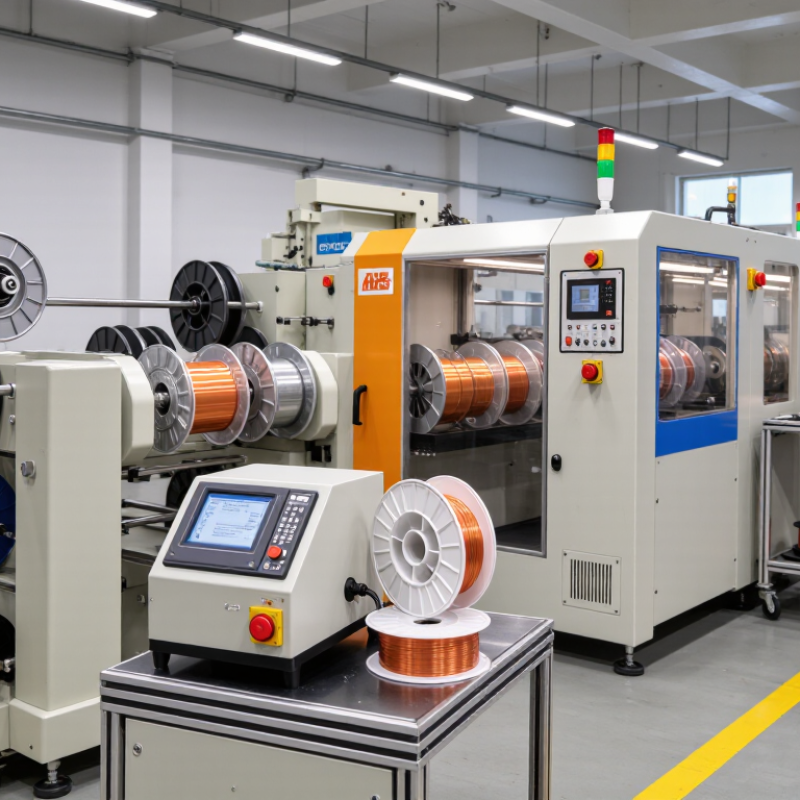
Define Wire and Conductor Requirements Using IEC 60228 and ASTM B258
How to Choose a Wire Winder in 2026?
A reliable wire winder starts with the conductor, not the machine catalog. IEC 60228 helps define conductor classes, nominal cross-sectional areas, and maximum resistance values. Select whether the conductor is solid, stranded, or flexible. That choice affects bending, tension, and winding stability. A 16 mm² stranded conductor may need gentler handling than a solid conductor with the same area. Check resistance at 20°C, because higher resistance can reveal an unsuitable material or undersized conductor.
ASTM B258 provides standard nominal diameters and cross-sectional areas for AWG and kcmil conductors. Use it when your production documents specify North American sizing. Do not convert AWG into diameter casually. Compare the stated conductor type, strand construction, and tolerances. The bare conductor size is not the finished cable diameter. Insulation, shielding, and jackets can increase the winding diameter significantly.
Measure the actual cable sample. Carefully. Record its diameter at several points, then use the largest practical value for guide and spool calculations. Match the winder’s tension range, traverse width, spool capacity, and minimum bending radius to those measurements. A narrow guide can mark insulation. Excessive tension can deform soft strands. I would also verify line speed under low-load testing. Specifications sometimes look precise, but real cable surfaces are rarely perfect. Recheck the setup after temperature changes, because flexibility and resistance may shift.
Match Winder Type to Wire Diameter, Tension, Spool Size, and Core Shape
How to Choose a Wire Winder in 2026?
A wire winder should match the wire, not merely the target speed. Measure diameter with a calibrated micrometer, including insulation or coating. Fine wire needs smooth guides and sensitive tension control. Thick wire often requires stronger torque and a rigid payoff path. For round wire, a precision traverse winder can create even layers. Flat or shaped wire may need a wider guide and controlled lay angle. The wrong winder can leave crushed edges, loose loops, or telescoped coils. I have seen an apparently suitable spool fail because its core radius was too small.
Tips: Record wire diameter, tensile behavior, spool width, flange diameter, and core shape. Test tension at the start, middle, and finish. A small sample coil reveals more than a catalog table. Keep notes from every trial.
Check the tension range at operating speed, not only at idle. Tension must remain stable as spool diameter changes. Match the chuck or arbor to the core shape, whether cylindrical, grooved, or keyed. Verify flange clearance; a few millimeters can prevent rubbing. Ask for trial winding with your actual wire and spool. Document line speed, tension, traverse pitch, and coil appearance. Some calculations look exact, yet material variation still matters. That part is easy to underestimate.
Calculate Speed, Traverse Ratio, and Capacity from Required Output
How to Choose a Wire Winder in 2026?
Calculate Speed, Traverse Ratio, and Capacity from Required Output
Start with the required output, not the machine catalog. If production needs 120 kilograms per hour, convert that mass into wire length. Linear mass depends on wire diameter, material density, and coating. For a round wire, calculate cross-sectional area with πd²/4. Then divide mass flow by density and area to estimate line speed. Keep units consistent. A small unit error can produce an impressive, useless result.
Spindle speed changes as the coil diameter grows. Estimate revolutions per minute by dividing line speed by π times the current winding diameter. Use the smallest and largest coil diameters to define the speed range. The traverse ratio needs equal attention. Calculate it as the wire lead per revolution divided by wire diameter. A ratio near one usually supports adjacent winding, while a larger value creates wider spacing. Actual results depend on tension, wire stiffness, and surface friction.
Capacity should match the required run length, with practical allowance for empty edges and imperfect filling. Estimate usable spool volume, multiply by a realistic fill factor, and compare it with required wire volume. Do not use the spool’s external volume alone. It overstates production capacity. I once trusted a neat capacity calculation and ignored coating thickness; the planned changeover arrived too early. Test a sample coil, measure its real mass, and revise the assumptions before selecting motor power or control range.
How to Choose a Wire Winder in 2026? Calculate Speed, Traverse Ratio, and Capacity from Required Output
The chart estimates the required line speed and minimum net spool capacity for a two-hour winding run at different production targets. The traverse ratio is set at 1.00, meaning the traverse pitch equals the wire diameter for level winding.
Calculation basis: 1.00 mm copper wire, copper density of 8.96 g/cm³, 85% effective line utilization, and a two-hour spool-change interval. Wire speed = required output ÷ wire mass per metre. For 1.00 mm copper wire, the calculated mass is approximately 7.04 g/m. Spool capacity = required output × 2 hours. Traverse pitch = wire diameter × traverse ratio, so a 1.00 ratio produces a 1.00 mm pitch.
Compare Changeover Time, Energy Use, Maintenance, and Total Cost per Coil
How to Choose a Wire Winder in 2026?
A wire winder should be judged by coil cost, not purchase price alone. Record three changeovers with a stopwatch. Measure unloading, mandrel adjustment, threading, and first acceptable coil. A five-minute delay per coil becomes costly across several shifts. In practice, operators often underestimate setup losses. I did too.
Energy use deserves equal attention. The U.S. Department of Energy reports that motor-driven systems consume more than half of industrial electricity. Compare measured kilowatt-hours per finished coil, not motor nameplate power. A 2024 energy-efficiency report from the International Energy Agency also identifies industrial efficiency as a major emissions-reduction opportunity. Install a temporary power meter during normal production. Empty running time can be surprisingly large.
Maintenance changes the calculation. The DOE Operations and Maintenance Best Practices guide estimates that effective maintenance can reduce industrial energy use by 5–20 percent. Check bearing access, tension-control stability, sensor replacement time, and spare-part availability. Then calculate total cost per coil: energy, labor, wire waste, planned maintenance, unplanned downtime, and depreciation. Include training hours. Include rejected coils. A cheaper machine may lose its advantage after one difficult repair. The comparison remains imperfect unless production data covers different wire diameters, speeds, and operators. Use a 30-day trial record where possible.
How to Choose a Wire Winder in 2026? — Compare Changeover Time, Energy Use, Maintenance, and Total Cost per Coil | Winder Configuration | Typical Wire Diameter | Coil Mass | Average Changeover Time | Net Output | Energy Use per Coil | Maintenance Hours per Month | Annual Maintenance Cost | Total Cost per Coil | Best-Fit Application |
| Manual single-spindle winder | 0.20–1.00 mm | 25 kg | 18.0 min | 34 coils/shift | 7.8 kWh | 10.0 h | $4,200 | $15.56 | Low-volume production and frequent product trials |
| Semi-automatic dual-spindle winder | 0.30–1.60 mm | 35 kg | 10.5 min | 49 coils/shift | 10.6 kWh | 14.0 h | $5,600 | $16.72 | Mixed batches with moderate changeover frequency |
| Servo-controlled dual-spindle winder Balanced choice | 0.25–2.00 mm | 40 kg | 6.2 min | 62 coils/shift | 10.6 kWh | 16.0 h | $6,800 | $16.42 | General-purpose production with varied coil sizes |
| High-speed automated multi-spindle winder | 0.40–2.50 mm | 50 kg | 3.5 min | 78 coils/shift | 10.6 kWh | 22.0 h | $9,600 | $16.75 | High-volume production with standardized coil programs |
| Heavy-duty low-speed winder | 1.00–4.00 mm | 75 kg | 8.0 min | 40 coils/shift | 16.8 kWh | 18.0 h | $8,200 | $22.38 | Large coils, high-tension wire, and heavy-gauge applications |
| Cost basis: Reference operating benchmark for a two-shift, 250-day production year. Total cost per coil includes allocated equipment cost, electricity at $0.12/kWh, direct labor at $24/hour, routine maintenance, and standard packaging or consumables. Actual results vary with wire material, coil dimensions, speed settings, labor rates, utilization, and electricity prices. |