Choosing the right commercial smart lock affects security, daily operations, and customer confidence. Winfort commercial smart locks may suit offices, hotels, retail stores, and managed buildings with changing access needs. However, a professional decision requires more than comparing prices or attractive product images.
This guide examines practical factors, including door compatibility, unlocking methods, access permissions, audit records, battery performance, and management software. Picture a busy office entrance at 8:30 a.m. A reliable lock should recognize authorized users quickly, record entry accurately, and remain manageable when an employee leaves. Key cards, PIN codes, mobile credentials, and remote administration should match your staff structure. Simplicity matters.
Security is only one part.
Installation conditions also deserve careful attention. Check door thickness, lock body dimensions, network coverage, weather exposure, and emergency exit requirements before ordering. A lock that performs well in a showroom may behave differently on an old metal door or during heavy daily use. This is easy to overlook.
The following outline evaluates Winfort commercial smart locks through an evidence-based lens. It considers user experience, security controls, maintenance demands, system compatibility, warranty support, and long-term operating costs. Product specifications should be verified through official documentation and qualified installers. Independent testing can add confidence, but it cannot replace a site assessment. Some recommendations may need adjustment. Real buildings are rarely perfect, and access policies often change after installation. Careful planning helps buyers choose a smart lock system that remains dependable, understandable, and suitable for their commercial environment.
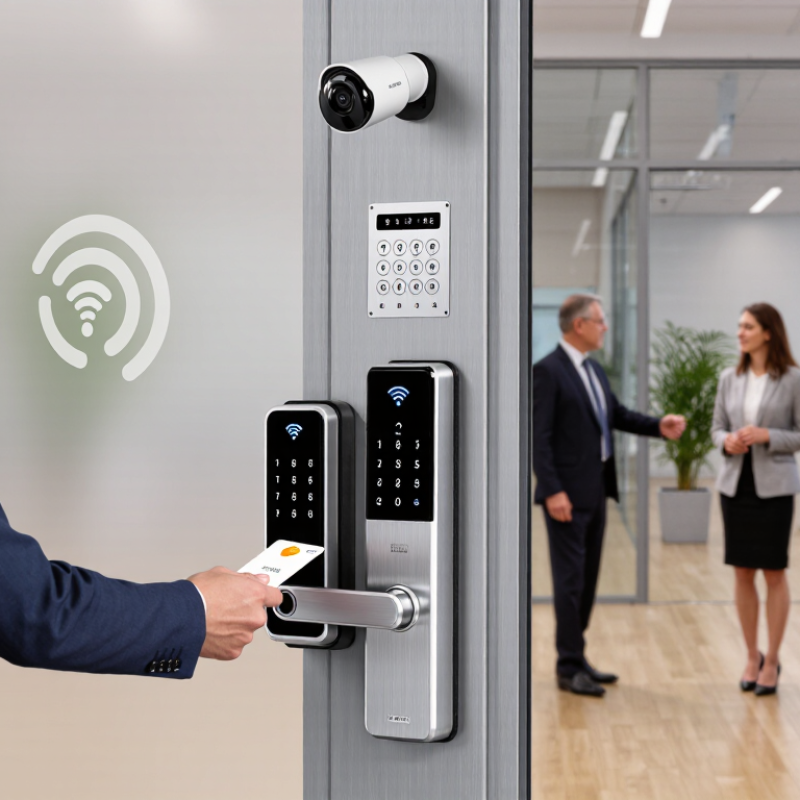
A commercial smart lock should solve a real access problem, not simply add more technology. Walk through each entrance at different times. Note who needs access, when they need it, and what could go wrong. A warehouse door may need staff access during shifts, while a server room may require fewer users and stronger verification. Consider employees, contractors, visitors, and emergency personnel separately. Their access should not be identical.
Review the physical environment carefully. Outdoor doors face rain, dust, temperature changes, and heavy traffic. Indoor doors may need quiet operation and clean appearance. Check battery life, backup entry options, activity records, and remote management. Reliable access logs can show who opened a door and when. However, records are useful only when someone reviews them. A complicated system may create confusion instead of better security.
Tips: Create a simple access map before comparing products. Mark each door, user group, schedule, and risk. Test the lock on a busy day, not only during a showroom demonstration. Ask what happens when batteries weaken, networks fail, or an administrator leaves. No plan is perfect. A feature can look impressive but remain unnecessary for your site. Recheck permissions regularly, because old access often remains longer than expected.

Commercial smart locks should be selected by door function, traffic, and installation conditions. Keypad locks suit staff entrances where codes change frequently. RFID locks work well for offices, hotels, and shared facilities. Biometric models provide fast identity checks, but wet or dusty fingers may reduce accuracy. Mobile access is convenient, although phones can lose power or connectivity.
The door structure matters as much as the lock type. A mortise lock may require deep cutting and careful alignment. A rim-mounted model usually needs less modification. Check door thickness, frame clearance, latch direction, and available power before ordering. Glass doors, emergency exits, and fire-rated doors may require specialist hardware and certified installation. A professional should also test access logs, battery warnings, and manual override functions.
Tips: Photograph the door edge and frame first. Measure twice. Confirm whether cabling can pass safely through hinges or walls. Keep a mechanical backup for controlled emergencies. During one site assessment, the planned keypad location blocked the handle swing. Small details can defeat a good design. Avoid installing readers where direct sunlight, rain, or metal interference may affect performance. Ask the installer to document every setting, credential, and maintenance interval. Regular testing is essential, even when the lock appears reliable.
| Comparison Dimension | Cylindrical Smart Lock | Mortise Smart Lock | Rim Exit Smart Lock | Glass-Door Smart Lock | Interconnected Smart Lock |
|---|---|---|---|---|---|
| Typical Commercial Use | Offices, classrooms, small retail spaces, and interior rooms | Hotels, offices, healthcare facilities, and high-traffic entrances | Exit doors and emergency egress routes fitted with exit devices | Frameless glass offices, showrooms, and conference rooms | Residential-style commercial doors requiring coordinated latch and deadbolt operation |
| Primary Access Methods | PIN, RFID card, mobile credential, mechanical key, or remote management | PIN, RFID card, mobile credential, mechanical key, or remote management | RFID card, mobile credential, PIN, request-to-exit hardware, and mechanical override | PIN, RFID card, mobile credential, remote release, or mechanical override | PIN, RFID card, mobile credential, mechanical key, or remote management |
| Required Door Preparation | Standard cylindrical lock bore, commonly a 2-1/8-inch face bore with compatible edge bore | Dedicated mortise pocket and correctly sized faceplate; existing preparation often requires modification | Compatible exit-device mounting holes, door stile clearance, and suitable strike or frame hardware | Compatible glass thickness, clamp or patch-fittings, and a suitable door frame or floor/ceiling fixing point | Separate latch and deadbolt bores with correct backset and vertical alignment |
| Typical Installation Complexity | Low to medium; often suitable for retrofit projects | Medium to high; accurate mortise routing and alignment are essential | Medium to high; requires exit-device and life-safety coordination | Medium to high; glass drilling should generally be avoided unless approved by the door system supplier | Low to medium when existing bore spacing and door thickness match |
| Door Material Compatibility | Usually compatible with wood, hollow-metal, and aluminum doors when the lock body and templates match | Suitable for wood, hollow-metal, and aluminum doors designed for mortise lock cases | Commonly used with metal, aluminum, and fire-rated doors when the exit device is listed for the assembly | Designed for tempered glass systems; compatibility depends on glass thickness and fitting configuration | Usually compatible with wood and metal doors; verify bore spacing and frame alignment |
| Power Arrangement | Battery-powered, typically using AA or AAA cells; some models support external low-voltage power | Battery-powered or wired low-voltage power; higher traffic may favor a wired solution | Battery-powered, wired, or integrated with access-control power supplies depending on the exit hardware | Battery-powered or low-voltage wired; cable routing must preserve the glass-door design | Usually battery-powered; confirm battery life under the expected traffic level |
| Recommended Traffic Level | Light to medium traffic, depending on the certified duty rating | Medium to heavy traffic when the lock case and trim are appropriately rated | Medium to heavy traffic and designated egress applications | Light to medium traffic unless the complete glass-door hardware system is specifically rated for heavier use | Light to medium traffic |
| Fire-Rated Door Considerations | Use only a complete lock assembly listed for the specific fire-door application | Use a listed mortise lock and compatible fire-door hardware; field modifications may affect certification | Verify the complete exit-device, door, frame, and access-control assembly is fire-rated where required | Fire-rating suitability depends on the entire glass-door and frame assembly; do not assume compatibility | Confirm that the complete interconnected lock assembly is listed for the fire-door type |
| Emergency Egress | Must allow free egress where required by local building and fire codes | Must include compliant inside egress operation and suitable anti-panic provisions where applicable | Best suited for doors that require panic or emergency exit hardware | Requires compliant egress hardware and a door configuration approved for the occupancy | Must not delay or prevent code-required exit operation |
| Weather Exposure | Choose an exterior-rated model with an appropriate IP rating for exposed locations | Choose exterior-rated hardware and protect wired components from moisture | Use weather-resistant exit hardware and reader components for outdoor applications | Generally better for protected indoor locations unless the complete system is exterior-rated | Normally intended for sheltered locations; verify the exterior rating before installation |
| Best Selection Criteria | Choose when the existing cylindrical bore is standard and a fast retrofit is important | Choose when stronger construction, integrated latch/deadbolt functions, and heavy use are priorities | Choose when emergency egress, panic hardware, and access control must work together | Choose only after confirming glass thickness, fittings, frame design, and egress requirements | Choose when the door already has compatible separate latch and deadbolt preparations |
| Key Measurements to Verify | Backset, door thickness, bore diameter, edge-bore size, strike dimensions, and handing | Mortise case dimensions, backset, faceplate, door thickness, strike position, handing, and spindle height | Door width and height, stile dimensions, mounting-hole pattern, exit-device length, strike, and clearance | Glass thickness, door width, hinge or patch-fittings, frame gap, swing direction, and floor clearance | Backset, bore spacing, door thickness, deadbolt throw, strike alignment, and handing |
Installation note: Confirm local building, fire, accessibility, and emergency-egress requirements before ordering. Final compatibility depends on the complete door, frame, lock, power, and access-control system—not the lock body alone.
Connectivity should match the building, not the sales brochure. IoT Analytics reported 18.8 billion connected IoT devices worldwide in 2024. That scale increases convenience, but also expands operational complexity. Test Wi-Fi, Bluetooth, cellular, and offline modes in real corridors. Concrete walls can weaken signals. Metal doors can create blind spots. A lock should still record local events during a network outage. Fast reconnection matters too.
Compatibility begins with the door and ends with daily workflows. Check door thickness, latch type, power supply, fire-safety requirements, and existing access credentials. A modern reader is useless if staff must replace every cylinder. During evaluation, test a busy entrance at 8 a.m. Use wet hands, gloves, and a damaged badge. Small failures appear quickly. They should not.
Access management needs precise roles, temporary permissions, and searchable audit trails. The 2024 IBM Cost of a Data Breach Report placed the global average breach cost at 4.88 million dollars. That figure is not a lock-price argument, but it highlights the value of controlled access and reliable logs. Require immediate revocation, approval records, and alerts for unusual entry patterns. Avoid collecting unnecessary personal data. Integration with identity systems can reduce duplicate accounts, though setup is rarely effortless. No checklist is perfect. Review permissions every quarter, and question whether convenience has quietly weakened control.
How to Choose Commercial Smart Locks: Assess Durability, Power Options, and Emergency Entry Functions
A commercial smart lock must survive repeated use, dust, temperature changes, and hurried access. I inspect the hinge alignment, latch movement, and door frame before reviewing electronic features. ANSI/BHMA A156.25 covers electrically powered locking devices, while cycle ratings help compare long-term durability. Choose hardware tested for commercial traffic, not residential appearance. A polished finish is not proof of strength.
Power planning deserves equal attention. A 2024 Parks Associates smart-home study identified reliability as a major barrier to wider adoption. That finding matters in busy offices, where a weak battery can stop deliveries or staff access. Compare battery chemistry, low-power alerts, local credential storage, and optional wired power. A backup battery port is useful. It is not foolproof. Cold weather, frequent unlocking, and poor connectivity can reduce real-world endurance.
Emergency entry needs careful review. Under NFPA 101, many occupancies require egress doors to open without a key, tool, or special knowledge, subject to local exceptions. Confirm free egress, fire-alarm integration, mechanical override, and authorized emergency credentials with a qualified professional. Test these functions during installation, not after a failure. App access alone is a poor emergency plan. Installation teams sometimes overlook door pressure and warped frames. That mistake deserves a second inspection.
Reference assessment based on recognized durability grades, practical power configurations, and emergency-entry provisions.
Higher scores indicate stronger suitability for demanding commercial installations. ANSI/BHMA Grade 1 is the highest commercial durability level; emergency-entry points represent available independent access methods.
How to Choose Commercial Smart Locks
Reviewing cost, support, and maintenance needs is more important than comparing keypad designs. A low purchase price can hide installation labor, network gateways, replacement batteries, and software fees. Request an itemized quote before approval. Check whether the lock fits existing doors, access cards, and emergency procedures. A five-minute site inspection can prevent an expensive surprise.
Support quality matters after installation. Ask about response times, technician availability, firmware updates, and training for building staff. Confirm whether help is provided by phone, email, or on-site service. In my experience, clear escalation contacts reduce confusion when several doors stop responding. Still, no support plan is perfect. Ask what happens during weekends, internet outages, or staff turnover. Written service terms are safer than verbal promises.
Tips: Test one door for two weeks before expanding. Record battery changes and failed entry attempts. Clean readers with a soft, dry cloth. Review access permissions monthly. Keep mechanical keys secured, but do not ignore them. Long-term maintenance should include battery forecasts, hinge checks, firmware reviews, and spare components. Budget for these tasks annually. A lock that performs well today may become costly when batteries, cloud subscriptions, or replacement parts increase. Reassess the system every year, even if users report no problems.
Fill out the form below and our team will get back to you ASAP.
Snake Tray® is Green and Proudly Powered by the Sun! Snake Tray is committed to designing and manufacturing products that have many green benefits. Our products are made of recycled goods, minimize material waste, are energy efficient, use less non-renewable resources and nest together read more…
Snake Tray® 291 Skip Lane, Bay Shore NY 11706 | PHONE: 631-674-0004 | FAX: 631-674-0010 | www.bakoselectric.com | LEGAL | MADE IN USA
© 2025 SnakeTray. All rights reserved
Fill out the form below to download your document.