Choosing the best Solar Water Pump in 2026 starts with the water, not the product brochure. How many liters must you lift each day? From what depth? Into a tank, a field channel, or a home system? These details shape the pump’s required flow rate and total pumping head. A mismatch can leave taps dry by afternoon, even beneath a bright sky.
Solar-pumping engineer Maya Chen offers this practical reminder: “Size the pump for the water your site needs, not the number on its box.” This is an original illustrative quote, not a verified quotation from a published expert. Treat it as a prompt to check the specifications carefully. Pump type, controller quality, panel capacity, storage, and seasonal sunlight all affect performance. A shaded panel at 3 p.m. matters. So does a well whose water level drops during dry months.
This guide compares the factors that matter before you buy, including direct pumping versus battery storage, installation needs, maintenance, and warranty terms. It also explains which figures to request from suppliers, so estimates can be compared on equal terms. One detail is easy to overlook: real output may fall below a neat catalog figure. That deserves a second look, not blind trust. With measured demand and site conditions in hand, you can narrow the options and choose a system suited to your daily water needs.
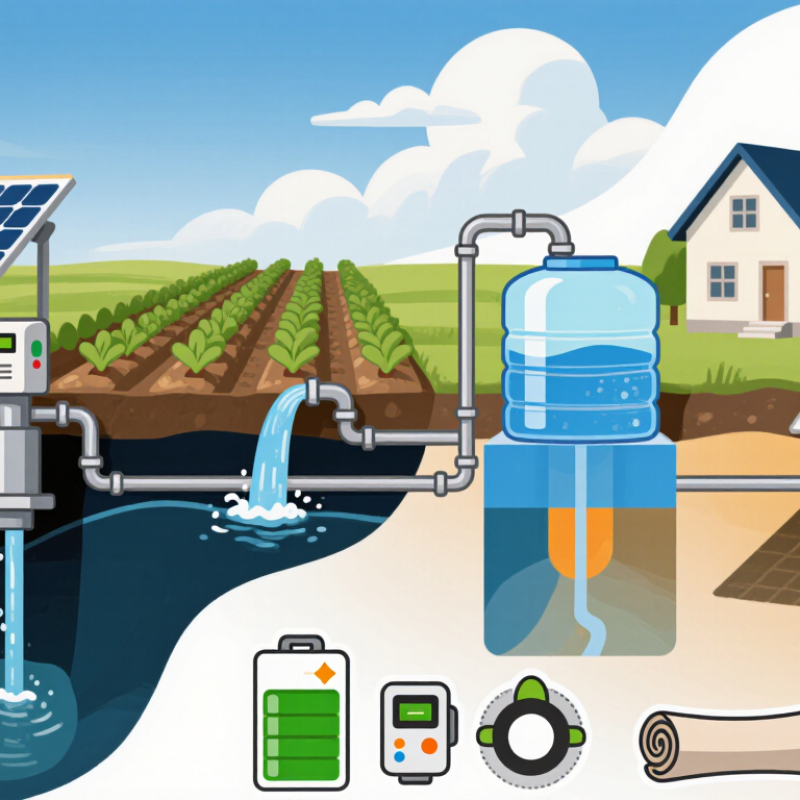
Before choosing a solar water pump, measure the source, not just the distance to it. Record the well’s static water level, pumping water level, seasonal changes, and recovery after pumping. For a stream or tank, check dry-season flow and usable storage. A short test can reveal a problem a sunny-day inspection misses.
Estimate daily demand by end use. The WHO report Domestic Water Quantity, Service Level and Health uses about 20 litres per person per day as a basic-access benchmark; actual household needs vary with sanitation, climate, and habits. For crops, FAO Irrigation and Drainage Paper 56 calculates crop water use from reference evapotranspiration and a crop coefficient. That means a vegetable plot in hot, windy weather can need much more water than the same plot in mild conditions. Count livestock separately, and include losses from leaks or inefficient irrigation.
Then compare the required daily volume with the source’s sustainable yield and the pump’s output at the actual total lift. World Bank/ESMAP guidance on solar water pumping stresses matching system design to water demand and pumping head, not headline flow rates. Ask for performance data at your measured lift, and plan storage for cloudy periods. A spreadsheet can still be wrong. I would recheck the water level near the end of the dry season; one visit is rarely enough.

Choosing the best solar water pump starts with two numbers: required flow rate and total pumping head. Start with daily demand. Add the water needed for household use, livestock, or irrigation, then divide that volume by the hours you expect the pump to run. Keep units consistent.
A practical example: moving 2,000 liters during five pumping hours requires an average flow of 400 liters per hour. Add a modest reserve for cloudy periods or changing demand, but avoid oversizing blindly. More capacity can mean higher cost and wasted energy. Check the pump’s flow rating at your calculated head, not just its maximum flow. That maximum often assumes little or no lift.
Now calculate total head. Include the vertical distance from the lowest expected water level to the outlet, plus elevation changes and losses from pipe length, bends, and fittings. A narrow, long pipe can noticeably reduce delivery. If the outlet needs pressure, include that requirement too; roughly 10 meters of water head equals 1 bar. Close enough for planning, not final design.
Measure carefully. Water levels shift seasonally, and estimates can be wrong. A simple site sketch with pipe lengths and heights helps reveal missing details. Compare your figures with the pump performance curve, then confirm expected output under realistic sunlight. The calculation is a starting point, not a guarantee.
How to read the chart: Each point is an example pump-sizing requirement, not a pump performance rating. Required flow is daily water demand divided by available pumping hours. Total pumping head (TDH) includes vertical lift, pipe and fitting losses, and any pressure needed at the outlet. Confirm these values for your site before selecting a pump.
Example assumptions: Garden: 2,000 L/day over 5 pumping hours; livestock: 5,000 L/day over 6 hours; irrigation: 10,000 L/day over 6 hours. The example TDH values are assumed planning estimates and should be recalculated using actual lift, pipework, and outlet requirements.
A solar pump should match the water source before it matches the panel. For a deep borehole, a submersible pump pushes water upward from below the surface. It avoids the suction limits that affect surface pumps. For a pond, tank, or shallow well, a surface pump may be easier to inspect and maintain. Measure the water level while pumping, not only when the well is full. That difference matters.
Water quality can change the choice. Clear water often suits standard centrifugal designs. Water carrying fine sand or grit can wear moving parts, so check the pump’s stated tolerance and use suitable filtration where needed. For modest flow at greater lift, a helical rotor pump may be worth comparing. Its slower output can suit livestock troughs or small irrigation lines. Not always. Match the pump’s flow and total lift to the actual job, including pipe friction and elevation changes.
Think about the daily use, too. Drip irrigation needs steady, controlled flow; filling a storage tank may need higher output during sunny hours. A direct solar setup can reduce system complexity, while a battery adds flexibility but also cost and maintenance. A common planning mistake is choosing by peak flow alone. I would recheck the well’s recovery rate before sizing anything; a strong pump can still outrun the water source.
A pump’s rated power alone cannot predict how much water it will deliver. Match its flow rate to the total dynamic head: the vertical lift plus friction losses in pipes and fittings. For example, a narrow, long pipe can reduce flow even when the pump and panels appear well matched. Estimate daily water demand, then check the site’s sunlight by month, not just on a clear summer day. NREL’s PVWatts documentation uses weather and system design inputs to estimate solar output, highlighting why location matters.
Allow for real-world losses. NREL’s PVWatts Version 5 manual sets a 14% default system-loss assumption for its standard grid-connected model. That figure is not a pump-sizing rule, but it shows why panel nameplate output should not be treated as usable power. Check the pump’s operating voltage and power range, controller compatibility, shading, dust, and hot-weather performance. A little extra panel capacity can help during weak-sun periods, though oversizing without checking the controller may waste money.
Tips: Compare expected daily water volume with demand at the site’s weakest-sun period. Measure pipe length and lift, and ask for pump performance data at your actual head. Small details matter. I would still verify the installer’s assumptions against a real flow test; estimates can miss awkward site conditions.
When choosing a solar water pump in 2026, compare its construction with the conditions at your site. A pump drawing water from a sandy well may need better protection against grit than one serving a clean storage tank. Check the stated operating limits, seals, and corrosion-resistant materials. Ask how often filters or other wear parts need attention. Small details matter.
Controls affect daily use. A basic controller may be enough for steady watering, while variable-speed controls can adjust output as sunlight changes. Look for clear fault indicators and dry-run protection, which can help prevent damage when a well runs low. Test the controls before installation if possible. A complicated display is not automatically useful.
Installation costs can exceed the pump’s listed price. Get an itemized estimate for panels, mounting hardware, wiring, pipe, trenching, and any water-storage tank. Ask whether the installer has sized the system for your required flow and lift; undersizing can leave taps or irrigation lines short of water. Warranty terms deserve the same close reading. Compare coverage for the pump, controller, and panels separately, and confirm who handles labor and shipping. I would not assume a long warranty means an easy repair. The fine print can change the calculation.
| Pump System Type | Best Suited For | Durability Considerations | Controls to Look For | Relative Installation Cost | Warranty Considerations |
|---|---|---|---|---|---|
| Solar DC submersible pump | Boreholes and wells where the pump must lift water from below ground. | Choose materials and seals suitable for the water’s mineral content and sediment level. Correct sizing helps avoid excessive wear and frequent starts. | Look for a compatible solar pump controller, dry-run protection, and a tank-level float switch or other automatic shutoff. | Medium to high. Borehole depth, pump capacity, wiring distance, and the need for well work or storage affect the total. | Pump and controller coverage varies by supplier. Check the covered parts, term length, labor exclusions, and whether installation conditions affect coverage. |
| Solar AC submersible pump with inverter | Deep wells or sites where an AC pump is preferred or already installed. | Can use a conventional AC pump, but the inverter adds another component that may need protection from heat, moisture, and electrical surges. | Confirm that the inverter is designed for the pump’s motor and solar input. Dry-run and overload protection are useful safeguards. | High. Inverter equipment, electrical integration, and any existing-pump upgrades can add installation work and cost. | Check pump and inverter warranties separately. Confirm whether the warranty requires particular wiring, protection devices, or qualified installation. |
| Solar DC surface pump | Shallow wells, ponds, tanks, and other water sources where the pump can be installed near the water. | Needs protection from weather, dust, and flooding. Surface pumps generally require priming, and suction lift is limited; actual limits depend on site conditions and pump design. | Useful controls include dry-run protection, a pressure switch for delivery systems, or a float switch for tank filling. | Low to medium. Installation is often simpler than a borehole system, but pipework, mounting, and water-source preparation still matter. | Review coverage for the pump, controller, and seals. Ask whether wear parts and damage from running dry are excluded. |
| Solar submersible helical-rotor pump | Applications that need relatively steady flow at higher head, often with modest water demand. | Rotor and stator wear depends on operating conditions and water quality. Sediment can increase wear, so source conditions and service access matter. | A matched controller with dry-run protection is important. Tank-level control can prevent unnecessary operation once storage is full. | Medium to high. The pump, required depth, solar array, and ease of servicing determine the installed cost. | Check whether the rotor and stator are treated as wear parts and whether replacement labor or parts are covered. |
| Solar booster or pressure pump | Moving water from a storage tank to taps, irrigation lines, or another point of use; it is not normally a substitute for a deep-well lift pump. | Protect the pump from dry running and excessive cycling. A suitable pressure vessel or control arrangement may reduce frequent starts. | Pressure control, dry-run protection, and a tank-level interlock can help match operation to household or irrigation demand. | Low to medium. The total depends on required pressure, flow, pipework, and whether storage or electrical equipment is already in place. | Check the pump and controller terms, especially exclusions for continuous operation, dry running, and unsuitable water conditions. |
| Cost and warranty note: Installation cost levels are relative planning guides, not price quotes. Actual costs depend on location, well depth, required flow and pressure, solar array size, storage, site access, and labor. Warranty terms differ by product and seller; compare written coverage and exclusions rather than relying on a general warranty duration. | |||||
Fill out the form below and our team will get back to you ASAP.
Snake Tray® is Green and Proudly Powered by the Sun! Snake Tray is committed to designing and manufacturing products that have many green benefits. Our products are made of recycled goods, minimize material waste, are energy efficient, use less non-renewable resources and nest together read more…
Snake Tray® 291 Skip Lane, Bay Shore NY 11706 | PHONE: 631-674-0004 | FAX: 631-674-0010 | www.bakoselectric.com | LEGAL | MADE IN USA
© 2025 SnakeTray. All rights reserved
Fill out the form below to download your document.